







Pay Transparency: The Moment of Truth for Managers

The European directive on pay transparency will be reviewed by lawyers, overseen by HR directors, and audited by consultants. But its first real test will take place behind closed doors, between an ill-prepared manager and an employee demanding answers. As long as organizations focus their efforts on compliance, they will miss the point of what it really is: a full-scale stress test of their frontline management.
Thomas leads a team of twelve people. As he walks past the coffee machine, he overhears a conversation among several of his employees. They’re talking about their right to receive information about compensation and the explanations they can request. Thomas continues on his way as if nothing had happened, but he feels a knot in his stomach. Because when those questions come up, he’ll be the one who has to answer them. And he isn’t ready.
This scenario could play out thousands of times in European organizations. Although much has been written about the directive—its requirements, its timeline, its penalties—almost nothing has been said about the person who will bear the operational burden: the front-line manager. This is a blind spot that is far from trivial, because transformations rarely fail when they are announced, but rather when they must be put into practice, explained, and defended in the face of real people.
And when it comes to pay transparency, what needs to be addressed is not an organizational chart or a process. It is each person’s sense of fairness, one of the most sensitive issues within an organization.
But what happens when those who are supposed to uphold it become one of its main points of vulnerability?
A MANAGEMENT ROLE ALREADY UNDER PRESSURE
Line managers didn't have to wait for pay transparency to see their workload increase. As organizations have streamlined their operations, hierarchical layers have disappeared and teams have grown larger. Their “span of control” - or the number of employees they supervise - has reportedly even increased by a factor of 2.8 since 2017 in some companies.1 At the same time, they are devoting an increasing portion of their time to reporting and administrative tasks, often at the expense of supporting their teams.
Over the years, these have been compounded by a series of transformations, each requiring its own set of adjustments: digitalization, agile methods, the widespread adoption of hybrid work, and the growing importance of CSR issues. Very often, it falls to the line manager to explain these changes, manage their practical implications, and secure the teams’ buy-in.
Finally, the very nature of the role puts managers at risk, since they are called upon to implement decisions he did not make, while also relaying realities that management is not always ready to hear. Caught in the middle, it often falls to them to absorb the tensions and contradictions. Being approachable without being complacent, setting high standards without burning people out, fostering loyalty without being able to make promises… The list of competing expectations has grown faster than the resources allocated.
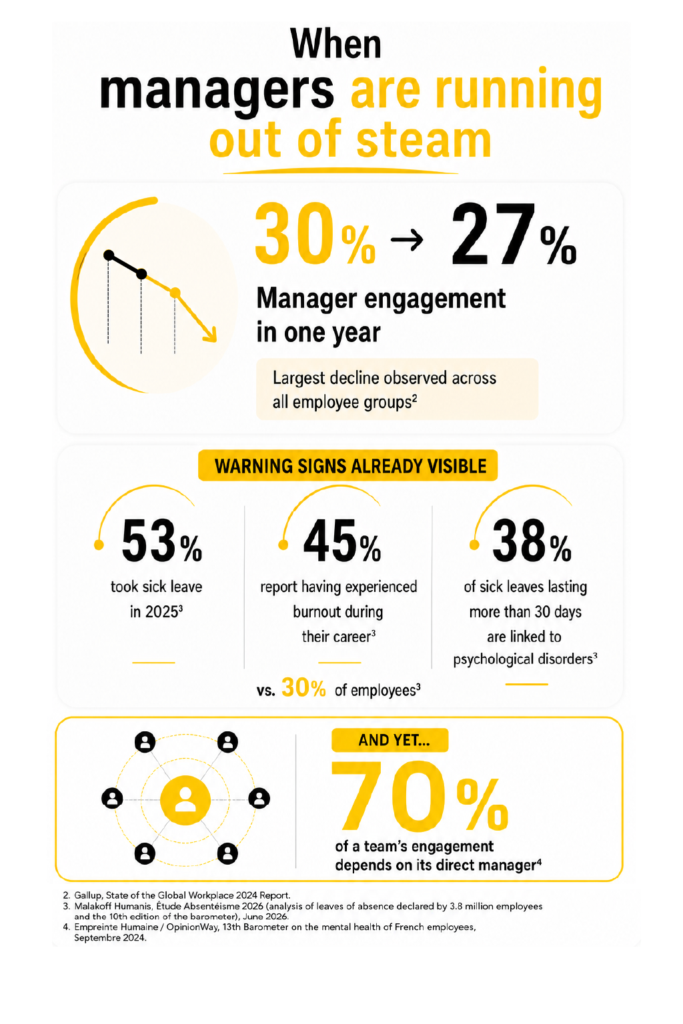
The surveys on engagement clearly reflect this reality. Managerial engagement has declined, even though managers remain one of the main drivers of engagement within organizations. In other words, managerial disengagement is not confined to the individual experiencing it; it spreads to the entire team.
The cost is already reflected in organizations' operating costs, spread across employee turnover, absenteeism, and decreased performance. Depending on the employee’s profile, the cost of replacing a departing employee can even reach twice their annual salary.2 However, these expenses are rarely attributed to the state of middle management, which makes them politically invisible and thus perpetuates the problem over time.
The consequences are not merely organizational or financial. The figures on sick leave and burnout (see infographic) show that they are also reflected in the health of managers themselves. This exhaustion has built up over the years in organizations that have not adequately addressed its causes.
Pay transparency, therefore, does not fall on a managerial role that is already functioning smoothly. It falls on a role that is already under strain, one that will now be expected to master a subject rarely taught: talking about money.
SALARY: A FRENCH TABOO
Explaining and justifying compensation is a skill that most organizations have never deemed it worthwhile to teach their managers. This is generally not a deliberate choice, but rather the result of a deeply ingrained culture.
In fact, in France, salary remains one of the last major taboos. It is still uncommon—and even considered socially unacceptable, to disclose how much one earns. Bourdieu’s concept of “habitus” sheds light on this phenomenon. It refers to the set of reflexes that a person internalizes over the course of their life, causing them to act “naturally,” without calculation or deliberation.3 Applied to our topic, this concept shows that the silence surrounding money stems less from a rule than from a deeply internalized social reflex. However, a reflex does not disappear simply by reading a memo or watching a PowerPoint presentation.
Yet the conversations that managers will face present a host of challenges. They will need to understand the compensation policy and master its criteria; translate them into accessible language without distorting their meaning; handle the emotional weight of a conversation in which the other person feels wronged; respond to comparisons between colleagues without violating confidentiality or creating further injustice. None of this can be improvised. Yet many will have to learn to do it on their own, in real-life situations and without prior experience.
Added to this is a legal requirement. The Pay Transparency Directive shifts the burden of proof in legal disputes: when an employee presents evidence suggesting discrimination, it is up to the employer to prove that no discrimination exists. In this context, any explanation given regarding compensation can be used against the company. Off-the-cuff remarks, even if made in good faith, such as “it’s a matter of potential” or “you have less seniority”, could be interpreted as reflecting subjective criteria and become part of the case file.
A manager’s lack of preparation could therefore itself become evidence against them. And an organization that exposes its managers to this type of discussion without providing them with the necessary guidance will struggle to defend the soundness of its compensation practices in the event of a dispute. It would be easy to believe that training alone is sufficient to reduce this risk. Although training is essential, it faces a structural limitation. One can learn to explain a decision; however, training alone cannot grant authority over a decision that one has not made.
EMBODYING DECISIONS THEY HAVE NO CONTROL OVER
In many organizations, the line manager is often still seen as the one who decides their team’s salaries. However, budgets are set elsewhere, budget decisions are constrained by finance, and some hiring decisions are entirely beyond the manager’s control. His or her decision-making authority is often limited.
However, the very essence of the directive is that it does not focus on identical positions, but rather on “work of equal value.” An employee can now request the average pay of colleagues in a position deemed equivalent to their own, even if the job title differs.4 This equivalence is based on a job evaluation using four criteria: skills, effort, responsibilities, and working conditions.5 Two very different jobs may thus end up in the same pay grade, or be placed in different ones, following a technical decision in which the line manager is not necessarily involved.
In this context, it is difficult to explain to an employee why their position is worth “as much” or “less than” someone else’s based on a pay scale that they neither created nor, in some cases, even consulted. The most important decision may elude them entirely, even though it is precisely the one they will be asked to defend.
In the eyes of the employee, however, it is still the face of the decision that matters. Since John Stacey Adams’s work on equity, we have known that the sense of pay fairness arises from comparisons with close reference points, first and foremost, colleagues, rather than the market in general.6 Since the directive will provide these points of reference, backed by figures, the frustration it creates will therefore, by its very nature, be interpersonal and local. It will not be directed at an abstract policy, but at the manager who embodies it on a daily basis.
The problem is that even the decisions he actually made do not always stand up to scrutiny. Moreover, salary decisions are often made under conditions that foster biases: time constraints, incomplete information, or vague criteria. Biases such as affinity bias, recency bias, and seniority bias thus continue to have an impact, as salary opacity has long deprived organizations of any mechanism for correction.7
That is why, even though we have been enacting laws on workplace equality for decades, the 16% pay gap between male and female executives, as measured by APEC in 2026, still reflects this cumulative effect.8
The irony is cruel: the lack of transparency that allowed biases to flourish also shielded managers from being held accountable. The directive removes both protections at the same time.
Managers therefore find themselves in a unique position: they cannot confidently defend the rules that have been set for him, nor those they have inherited, nor anything he has built himself. That leaves one final possibility: that a loyal manager continues to defend the system despite its imperfections. Yet transparency might give them reason to doubt it.
WHEN THE SYSTEM FAILS TO DELIVER ON ITS PROMISES
Many managers have accepted an increasing workload, expanded responsibilities, and sometimes difficult trade-offs because they believed in an implicit promise: that their effort, commitment, and loyalty would eventually be recognized. Sociologist David Courpasson has described this driving force: in modern organizations, commitment is not based on coercion, but on this implicit pact, which is accepted as long as it seems fair.9
However, this agreement now faces a reality that is well known in compensation policy. In a tight labor market, attracting a candidate often requires offering compensation in line with the external market, while internally, budgets for raises remain limited. Over time, these trajectories may converge, leading to some new hires being recruited at a level close to, or even higher than, that of managers who have been in their positions for several years.
Salary is never merely financial compensation. It also serves as a sign of recognition and an indicator of one’s standing within the organization. When a manager discovers that a newcomer earns more than he or she does, he or she may feel that the rules of the game to which he or she agreed are no longer producing the expected results.
The situation is all the more delicate because the manager becomes both judge and jury. When an employee discovers an unfavorable discrepancy, they can challenge the system. A manager who discovers a discrepancy in their own performance must continue to explain it away. This tension creates a dissonance that is difficult to sustain over the long term. Either people leave, or one changes their tune. In the latter case, commitment gradually gives way to doing the bare minimum or to silence.
And a reform intended to restore confidence, led by someone who himself doubts its fairness, even if he doesn’t say so, will often have the opposite effect of what was intended.
This is where the issue goes beyond the situation of managers alone. Research on organizational justice shows that employees are more likely to accept decisions that are unfavorable to them when the process that led to those decisions is perceived as fair: criteria that are known, applied consistently, and with effective avenues for appeal.10
The messenger’s credibility is necessary, but it is not enough. A sincere manager who advocates for a process perceived as opaque will not be believed; conversely, even the most rigorous system will lose its effectiveness if it is led by an exhausted or disillusioned manager.
When these two vulnerabilities converge, they do not merely result in a lack of support or a communication problem. They pave the way for a loss of credibility.
The failure is not confined to the salary discussion. A contested decision casts doubt on the next one. Comparisons among colleagues become more acrimonious. Requests for information multiply, no longer to understand, but to build cases. The likelihood of litigation increases. The organization thus finds itself in a paradoxical situation: more vulnerable after the reform than before it. The real risk, therefore, is not the manager as an individual, but the gradual erosion of middle management’s credibility.
PREPARING MANAGERS FOR THE MOMENT OF TRUTH
The good news is that this vulnerability is by no means irreversible. Even though the deadline for implementation has passed, these discussions are just getting started. So there is still a window of opportunity to take action. But to be effective, we must proceed methodically, because the order in which we tackle these projects matters just as much as their content. Communicating before making corrections, or putting managers on the spot before preparing them, would be like building a roof before laying the foundation.
1. Treat middle management as a high-risk group
Most companies view pay transparency as an HR or legal issue. However, its main operational risk lies elsewhere: at the middle management level.
Managers will be the first to face complaints, the primary interpreters of the rules, and the ones responsible for maintaining trust when the responses do not always meet expectations.
They must therefore undergo a specific assessment, not just the one required by regulations. Their level of understanding of compensation mechanisms, their actual decision-making authority, their exposure to salary compression, and their own buy-in to the system must be evaluated before implementation. After all, what is at stake here is their ability to sustain the system over the long term. An organization that is unaware of the state of its middle management is steering its reform blindly.
2. Correct whatever might weaken those who will have to carry the message
Not all issues can be resolved before the directive takes effect. However, some must be addressed as a priority because they directly affect the credibility of managers.
Salary compression, the most glaring historical inconsistencies, or disparities that have become difficult to justify undermine, from the outset, the message that will later be conveyed to the teams.
The question, therefore, is not just which discrepancies pose legal risks. It is also which ones will undermine the credibility of management’s message. A spokesperson whose case has been resolved is an ally; a spokesperson who has been wronged is a risk that resurfaces in every conversation.
In this area, the cost of preventive action is almost always lower than that of corrective action. Budgeting for these corrections now, with a clear head, will generally be less expensive than having to make them later, under pressure and in public.
3. Clarify the rules before asking managers to enforce them
Pay transparency will turn practices that are often implicit into explicit topics of discussion. Compensation criteria, promotion mechanisms, classification principles, and the division of responsibilities between HR and managers must be clarified before individual requests are accepted.
As long as these rules remain a set of unwritten customs, managers have to improvise, and improvisation is now as much a legal risk as it is a human one.
This applies first and foremost to the job evaluation framework. Since this grid will form the basis for the comparisons required by the directive, organizations would be well advised to involve managers in its development or, at the very least, to help them understand the logic behind it before they are called upon to defend it.
A simple test can be used to gauge how well-prepared the system is: present the same real-life case to several managers. If their explanations differ significantly, the problem lies not with the managers, but with the system itself.
4. Prepare responses and the sequence of messages in advance
Most organizations carefully prepare the messages they will release. However, they are less likely to anticipate the questions that managers and HR will have to answer once these messages are released. Yet the initial inquiries will rarely concern straightforward situations: they will focus on borderline cases, perceived inconsistencies, unfavorable comparisons, or past decisions.
It is therefore necessary to establish a response framework in advance. What deviations warrant corrective action? Which issues fall under the manager’s purview, and which are the responsibility of HR? What commitments can be made, and what deadlines can be announced? This preparation reduces the risk of contradictory responses and minimizes the impression of arbitrariness.
The sequence is just as important as the content. A manager should never learn the information at the same time as their employee. The order is non-negotiable: executives first, who publicly take responsibility for decisions and deviations; managers next, equipped with the necessary answers, data, and context; and finally, employees.
Reversing this order turns every manager into a lone bearer of bad news that he or she did not choose to deliver.
5. Train Managers Before They Have Those Conversations
Managers will not need an encyclopedic knowledge of the directive. Above all, they will need to know how to handle difficult conversations. The skill required is not technical; it is interpersonal.
Preparation must therefore be based on real-life situations: explaining a discrepancy without downplaying it, responding to a comparison deemed unfair, acknowledging an inconsistency without backtracking, and engaging in a discussion for which there is no immediate solution.
The most effective programs are based on scenarios developed from real-life cases within the organization. The best indicator of how seriously the program is taken is simple: the time and budget allocated to it.
6. Establish a sustainable framework for pay transparency
One of the most common mistakes is to treat pay transparency as a project to be rolled out, with a specific deadline. It’s an ongoing process, because these conversations will recur and become more intense as employees gain a better understanding of their rights and their data. What works today won’t necessarily work two years from now.
Organizations would therefore be well advised to track, over time, the issues raised by managers, the most contentious situations, recurring requests, and persistent misunderstandings. This tracking serves two purposes. To adjust compensation practices and to identify weaknesses in the system before they become sources of broader mistrust.
On one condition, however: that managers are not left to handle these situations alone. Regular opportunities to debrief on difficult situations, HR representatives who can be reached quickly in borderline cases, and a structured process for capturing lessons learned can help transform every challenge encountered into a collective learning experience rather than an individual ordeal.
AN OPPORTUNITY, NOT A BURDEN
Pay transparency will not create any of the problems described here. These biases already existed, as did the pressure on middle management and its growing fragility. It simply brings to light what opacity previously allowed us to circumvent or ignore.
This makes it particularly challenging. Because when the very people responsible for safeguarding the system are also its victims, transparency does not restore trust, it reveals its absence.
That is why the dividing line will also run between organizations that have treated the issue as a legal project and those that have understood that it is a cultural transformation, one that affects the way we talk about value, performance, and recognition. Yet, to date, the human aspect remains all too often an afterthought in this endeavor.
This assumes that executives and HR directors themselves embody the transparency they expect their managers to demonstrate. The directive therefore offers organizations a rare opportunity to rethink and rebuild the managerial contract before more costly conversations take their place. Otherwise, the countdown will continue.
Have a project? Contact us to discuss it…
Find out more about our client success stories!
- Gleb Tsipursky, “ Feeling burned out at work? Here's the solution. ", Washington Post, December 2025. ↩︎
- Malakoff Humanis, 2026 Absenteeism Study (analysis of reported sick leave for 3.8 million employees and the 10th edition of the annual barometer), June 2026. ↩︎
- Pierre Bourdieu, *Practical Sense*, Les Éditions de Minuit, 1980. ↩︎
- Directive (EU) 2023/970, Article 7. ↩︎
- Directive (EU) 2023/970, Article 4, paragraph 4. ↩︎
- John Stacey Adams, “Inequity in Social Exchange,” Advances in Experimental Social Psychology, vol. 2, 1965. ↩︎
- Mahzarin Banaji & Anthony Greenwald, *Blindspot: Hidden Biases of Good People*, Delacorte Press, 2013. ↩︎
- APEC, Gender Inequality, March 2026. ↩︎
- David Courpasson, Coercive Action: Liberal Organizations and Domination , PUF, 2000. ↩︎
- Jerald Greenberg, “Organizational Justice: Yesterday, Today, and Tomorrow,” Journal of Management, vol. 16, no. 2, 1990. ↩︎

You may also like…