







Maslow's Hierarchy of Needs: Understanding Needs to Optimize Employee Engagement

Why are some of your employees fully committed… while others are not?
You can't build a skyscraper on sand. Similarly, an employee can't perform at their best if their foundation isn't solid, if their basic needs aren't met.
This idea is not just intuitive: it is based on the work of Abraham Maslow, who showed that motivation is not a spontaneous impulse, but a hierarchical structure.
Each level of need must be sufficiently satisfied for the next one to become a driving force.
Maslow's hierarchy of needs is broken down as follows:
Physiological needs – Safety – Belonging – Esteem – Self-actualization.
In today's workplace, these needs show up in practical ways that are often more nuanced than they appear.
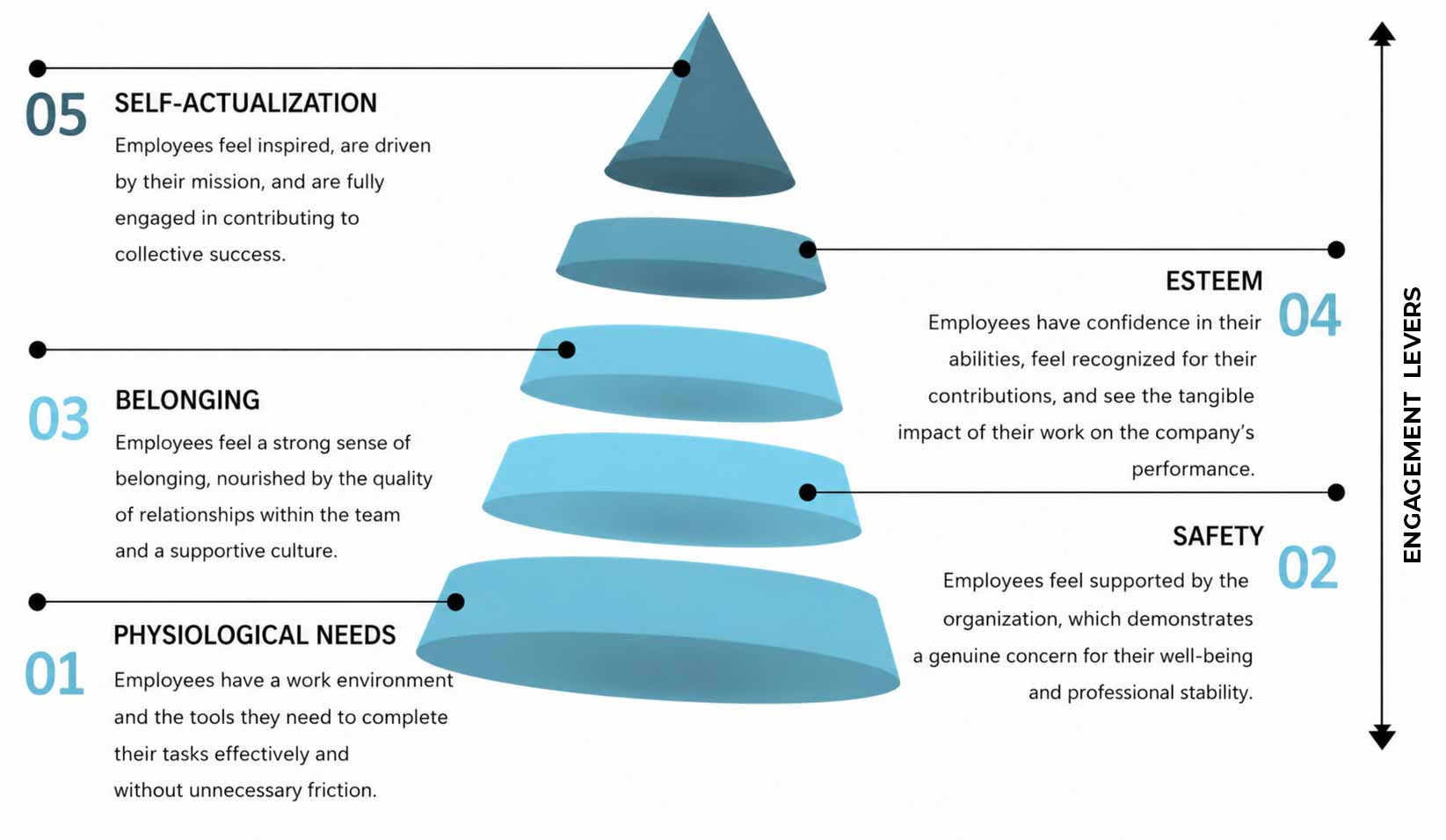
1. PHYSIOLOGICAL NEEDS: THE BASE OF MASLOW'S PYRAMID IN THE WORKPLACE
These are the fundamentals: an employee must have fair compensation, effective tools, and the information needed to do their job effectively.
These elements may seem obvious, but they form the foundation upon which employee motivation and engagement are built.
Without them, no lasting motivation can develop.
2. SAFETY & PSYCHOLOGICAL SAFETY IN THE WORKPLACE
Job security is not limited to having a stable job or employee benefits. or employee benefits. These remain essential because they allow employees to focus on their work without financial anxiety.
But beyond these foundations, there is another level: psychological safety.
It is this sense of security that allows employees to propose ideas, experiment, make mistakes, and learn without fear of unfair punishment.
This sense of security is built through:
- Clear and realistic expectations
- Regular, constructive feedback
- Recognition for employees' efforts
- A workplace culture that values experimentation and initiative
When it is present, it unleashes creative energy and enables the team to go beyond simply carrying out tasks.
Many companies believe they provide this level of security. However, when we measure how teams actually perceive it, there is often a discrepancy. Assessing these perceptions helps organizations identify where improvement efforts should be focused.
3. A SENSE OF BELONGING: A DRIVER OF EMPLOYEE ENGAGEMENT
The third level of Maslow's hierarchy of needs is reached when an employee can express their individuality while feeling like an integral part of the company.
This translates to:
- A healthy and stimulating work environment
- Company values that are consistently reflected in everyday actions
- A sense of pride and connection to the professional community
Belonging isn't about simply being part of the organization.. It's a feeling, a deep emotional connection that strengthens relationships and employee engagement.
4. RECOGNITION AND APPRECIATION IN THE WORKPLACE
Self-esteem reflects how people perceive their own value, abilities, and legitimacy.
It begins internally, with the feeling that one's efforts truly matter. It is then through the respect of colleagues and recognition from managers.
For this respect to take root, the company must provide a sense of purpose: explain its goals, demonstrate the tangible impact of employees’ work, and align its values with day-to-day practices.
When this sense of coherence is felt, work ceases to be merely an obligation and becomes a powerful driver of employee engagement. Career development opportunities then become an important source of motivation and growth for each individual’s development and commitment.
Many organizations discover, when they measure respect and recognition, that these vary greatly from one team to another. Supporting managers in the art of providing feedback, offering recognition, and clarifying purpose therefore becomes especially important.
5. SELF-FULFILLMENT AND SELF-REALIZATION: THE TOP OF MASLOW’S PYRAMID
At the top of Maslow's hierarchy of needs is self-actualization, which is linked to intrinsic motivation.
This motivation stems from the enjoyment, interest, and satisfaction that the activity itself provides.
It unleashes creativity, encourages initiative, and fosters long-term commitment at work.
According to self-determination theory (Edward Deci and Richard Ryan), three factors are essential:
- autonomy
- competence
- relatedness
In the professional world, this means:
- provide employees with enough flexibility to exercise autonomy
- support employees in developing their skills
- Foster rewarding and constructive working relationships
When these conditions are met, the employee can enter a state of flow, a concept developed by Mihaly Csikszentmihalyi: a state in which the individual is completely immersed in their activity, focused, and fully engaged.
Flow isn't just a pleasant state, it's the optimal condition for creativity, innovation, and sustained performance.
WHAT MASLOW'S HIERARCHY OF NEEDS REVEALS ABOUT EMPLOYEE ENGAGEMENT
Maslow's hierarchy of needs highlights a simple truth: engagement cannot be mandated. It is built gradually, as employees' basic needs are met.
A stable work environment, genuine psychological safety, a sense of belonging, recognition, and the opportunity for professional fulfillment are the key elements that enable each person to fully engage in their work.
When these elements come together, motivation becomes deeper and more lasting. Employees no longer simply carry out their tasks; they contribute, offer ideas, innovate, and actively participate in the collective effort.
At ACT-ON STRATEGY, we have observed that organizations that succeed in striking this balance develop stronger employee engagement and sustainable performance over time.
However, many companies want to boost employee engagement but aren’t always sure where to start. Measuring team perceptions, understanding managerial practices, and analyzing the fulfillment of fundamental needs helps identify the most effective levers for improvement.
The Teams ACT-ON STRATEGY support organizations in this process: assessing the level of engagement, shedding light on internal dynamics, and helping managers adapt their practices to create more motivating and sustainable work environments.
To learn more about this topic, you can also read this article on employee engagement, which explores the organizational factors that have a lasting impact on team engagement.
Have a project in mind? Contact us to discuss it.
Explore our client success stories!

You may also like…