









A frank, self-critical look at Tech’s pitfalls - and a few tips to tackle some major problems: the weight of collective unconscious in Tech’s mythical story, the difficulty in developing new talent from diverse backgrounds and the near-absence of women.
MOVING BEYOND RHETORIC… TOWARD CONCRETE ACTION!
In 2023, hiring developers remains challenging. This job is booming, profiles are in high demand and the market still struggles to match supply with demand.
Moreover, the field has yet to inspire vocations among more atypical backgrounds and the female population remains underrepresented.
If we want to change this situation - which hurts businesses and society - we must move past attempts to fix the digital problem at school purely by focusing on technology: for example, just loading up middle schools and high schools with gadgets.
Let’s consider other approaches - like teaching “language skills” to code, and thereby inspiring budding developers in the process…
Questions abound: how do we teach programming? Who does the teaching? How do we spark career interest? These are far more relevant issues that we need to address now.
CHANGING OUR PERSPECTIVE… TO DISCOVER AND REVEAL NEW TALENTS
This is ultimately about humans - their biases, identification needs, individual and collective imaginations, representations, and projections…
It seems logical, then, to bring in the social sciences and humanities: history, sociology, psychology, anthropology, ethnology. The idea is to bring in more unconventional profiles, to tap different learning and life journeys and thereby grow a new generation of developers.
One example is the work of Georges Balandier, who introduced the concept of “techno-imaginary” (the importance of machines in our contemporary imagination, shaped by mythical stories), and of Pascal Plantard - a digital anthropology researcher at Rennes 2 University (and, by the way, let’s not just focus on Paris for our reflections).
Plantard reminds us that techno-imaginaries form the foundational material of representations, fueling and guiding digital practices.
Studying this could help us figure out why young women self-censor. And we can move past “geek shut-in” clichés - because IT projects are often team efforts.
Indeed, research on techno-centrism encourages us to analyze these imaginary narratives, mostly shaped by Anglo-Saxon, male-dominated references. Part of our answer may lie there…
DRAWING ON REALITY… AND GIVING WOMEN THE PLACE THEY DESERVE…
Yet France - and other countries - boast numerous historical success stories and entrepreneurial models in research and industry that could match any Anglo-Saxon achievements (or those of Asia).
Take, for instance, the French company Jeulin, which, from the mid-1980s onward, offered educational solutions featuring touchscreens and robots for teaching computer science. Pascal Plantard highlights how this is rarely remembered.
Somehow, mainstream history remembers only the “great male programmers.” But if we go all the way back to the 1800s, we find Ada Lovelace - Lord Byron’s daughter and a friend of Charles Babbage - who invented the world’s first theoretical software algorithm!
Closer to our time, at Bletchley Park during WWII, pioneering women programmers cracked German codes. Alan Turing wasn’t alone - but he is the one widely featured in a movie…
And Margaret Hamilton was a key figure in the Apollo program, heading the flight software team. The term “software engineering” is hers. We might also mention African American women mathematicians in the US space program, as well as Grace Hopper, who - holding a Ph.D. in math - helped create COBOL in 1959.
…TO REWRITE TECH’S MYTHICAL NARRATIVES!
Though these pioneers were long overshadowed, the tide is gradually turning. That momentum is rewriting the grand mythical narratives and reshaping how we view both individual imagination and collective imagery in tech.
We should keep telling these big stories, much like France did with space exploration via Thomas Pesquet (another man!) and Claudie Haigneré - the first French woman in space - so young women no longer feel excluded from the digital universe.
WORKING LONG-TERM ON THE “EDUCATION, SOCIETY, RECRUITMENT” TRIPTYCH
Along with high-level changes, we must also tackle things at the grassroots. Specifically, our recruitment processes must be as open as possible: engineering schools, universities, short-track degrees like BTS…
The same goes for programming languages and Linux-type environments. That’s how we’ll find “tinkerers,” in the anthropological sense, where innovation is a process of borrowing, modifying or newly recombining existing elements, as paleoanthropologist Pascal Picq suggests.
Finally, let’s revisit how we engage with engineering schools, where faculty often fail to consider industrial concerns.
You see, shaking up the “education-society-recruitment” trio will take a major and extended effort to spark interest in every digital job (not just whatever’s hot right now).
In the end, the best way to train - and hire - more developers and especially women in this field might just be perseverance: picking up the pilgrim’s staff to inform and persuade countless people, for many (more) years to come!
Check out ACT-ON TECHNOLOGY job openings.
Got a project? Contact us.
Today, being a payroll manager no longer means (just) managing repetitive manual tasks. Thanks to the functionalities offered by management tools, payroll professionals have become data analysts within HR departments, and now play a role in providing information and advice to other departments, as well as to employees. Faced with the transformation of the profession, what are the fundamentals to follow? Here's a look at 10 best practices to help you excel!
1. ENSURE FLAWLESS, ON-TIME PAYROLL!
While the environment in which a payroll administrator works may be changing, the raison d'être of the job remains unchanged. It's all about ensuring that all payrolls are sent and received on time, and without error. This contributes to an optimal employee experience: any shortcomings in this area are likely to lead to disengagement and loss of confidence on the part of employees.
What's more, punctuality and accuracy in payroll are closely linked to job security: an essential factor at a time when more than 1 in 2 workers say they are concerned about the impact of the global economic situation on their income.[1]
A must for payroll professionals: to provide an accurate payslip, sent on time and without errors, it is now possible to rely on management tools that avoid spending time on repetitive tasks linked to data entry, monitoring and checking data reliability.[2]
2. MASTERING EARNINGS AND DEDUCTIONS...
Earnings and deductions codes make pay slip calculations complex. At a time when 93% of a payroll professional's time is still spent on recurring tasks,[3] a payroll automation solution can help you carry out this task without making mistakes, and save precious time... which you can use to answer employees' questions about the calculation of their payslip.
3. PROCESS CHANGES DURING THE PAYROLL CYCLE
To guarantee the best employee experience, it is essential to be able to process hours worked and overtime in real time, so that they are taken into account in the current month's payroll.
A key point to understand when upgrading your business: the processing of modifications depends on the retroactivity capability of your payroll solution, especially with the "fait générateur" (generating event) that will be implemented in 2027.[4] Once again, choosing the right tool can help you gain flexibility in this area.
4. APPLY THE 4-EYE RULE
When it comes to payroll, the 4-eyes rule means having a second person review and approve payroll changes made by one administrator.
As you know, payroll is the biggest expense for the majority of employers: this audit is a way of protecting the company, as well as yourself.
5. KEEP CERTIFICATIONS UP TO DATE
To guarantee payroll security, make sure your management tool is certified. By extension, you can also obtain certifications to keep up to date with best practices in your field, as well as to demonstrate your mastery of the payroll solution you're using. A great way to keep your expertise up to date!
How do you choose the right payroll solution provider?
Instinctively (and rightly), we think of selecting a tool whose functionalities help you to achieve your objectives: organization and data management, HR administration...
Another key point is that a supplier who supports you in the evolution of your business must be ISO-certified.[5] Legal innovations have an impact on day-to-day payroll management. In this respect, certification is a real vote of confidence, and a guarantee that the solution provided is effective.
6. HAVE A BACK-UP PLAN... ALWAYS!
What's the point of having a payroll contingency plan? This protective measure makes it possible to deal with unforeseen events, while respecting the time constraints imposed by the payroll cycle.
What does a contingency plan look like in practice? For example, you could create a process for revalidating payments from the previous period and correcting errors in the next payroll cycle. For this plan to be applicable in an emergency situation, it is essential to document and test it in advance. [6]
7. DOCUMENT PAYROLL PROCESS STEPS
This is essential to enable other professionals to take over in case of absence. To do this, arm yourself with pedagogy and train (or have trained) one or more of your colleagues.
These 4 tips will help you fulfill your mission:
- Take a step back and map out all the steps in the payroll process. Make sure you present them in a clear, easily accessible and comprehensible document.
- Test the process with the people who will be taking over from you, in your presence and on their own.
- Take the time to explain to your replacements all the issues and responsibilities involved in payroll management.
- Regularly update your payroll documentation.
8. PROVIDE RELIABLE REPORTS TO FINANCE
The data contained in the GL (General Ledger) report must be able to be processed automatically. Setting up your payroll management tool will enable you to calibrate the format of your reports so that they can be easily exploited, as well as limiting errors.[7] Mastering the tool that provides this data is therefore crucial: the trust placed in the payroll manager depends on it.
Finally, it's a way of streamlining work between the Finance and HR departments: as a payroll professional, you act as a link between these two business families.
9. STAY UP TO DATE WITH LEGAL AND CONVENTIONAL WATCH
Halfway between "Finance" and "HR", the payroll manager is also a legal referent: it is his or her responsibility to keep abreast of and apply current regulations.
How can I keep up to date with all the latest legal developments? While technical monitoring is essential, payroll professionals can also count on a high-performance payroll solution to apply all new legislation.
Some solutions on the market have been modeled, and legal and contractual monitoring is carried out directly by the publisher. [8]
Our expert payroll and payroll outsourcing can also help you with this time-consuming task 🙂
10. CREATE VISUAL, IMPACTFUL REPORTS FOR MANAGEMENT
A good analyst, the payroll manager is able to provide the CoDir, ComEx or ExCo with usable and comprehensible reports. This is a strategic mission, enabling them to pass on their expertise and support the company's development.
How can data analyses be presented so that they are fully accessible, understood and taken into account? For example, it's possible to use dashboards or graphs that can be accessed in real time, and shared with management.
THE WORLD OF PAYROLL IS NOT SET IN STONE...
In the digital age, the job of payroll administrator is gradually being enriched with new missions, going far beyond the calculation of remuneration.
Guaranteeing faultless payroll, mastering the subtleties of regulations, anticipating legal changes, documenting processes and reporting clear, reliable data: these are the fundamentals that enable payroll professionals to position themselves as an essential pillar of HR and Finance departments.
Far from being static, this role is constantly being reinvented, thanks to technological innovations and the transformation of organizations. By investing in the right solutions and adopting these best practices, you affirm the strategic role of payroll professionals within organizations, and play an active part in their evolution.
Armed with the right cards, it's up to you to play!
You want to professionalize your payroll department and...
- Adopt new practices at the cutting edge of digital technology?
- Evaluate your current tools and identify the functionalities that are essential in your context?
- Explore different ISO-certified payroll solutions to guarantee the security and reliability of your processes.
- Develop your skills through certification and specialized training.
- Call on our experts to help you implement a flawless payroll and build a genuine HR strategy.
Discover ACT-ON HRIS.
[1] OpinionWay Barometer, Confidence and well-being at work, 2022.
[2] French Ministry of Labor, Guide pratique du gestionnaire de paie, 2023 edition.
[3] Silae survey, Observatoire de la Paie, 2022.
[4] Collection reform project, Bulletin officiel des finances publiques, 2022.
[5] International Organization for Standardization (ISO), ISO 9001:2015 & ISO 27001:2013 standards.
[6] Ordre des Experts-Comptables, Les indispensables de la paie, 2021.
[7] Association nationale des directeurs financiers, Report on the digitalization of the finance function, 2021.
[8] Deloitte, Payroll digitization and outsourcing study, 2023.
According to a recent study by McKinsey, almost 40% of workers will need to acquire new skills by 2030 to remain competitive in the job market.[1] Indeed, AI is reinventing process automation on repetitive, low value-added tasks, freeing up time for higher value-added activities. A transformation that would operate like a veritable groundswell. But beyond the fears, there are real opportunities to be seized!
Far from being a simple replacement tool, AI acts as a catalyst for redefining and rethinking human roles. It stimulates creativity, facilitates collaboration and opens up new perspectives in a variety of fields, from science to the arts, not forgetting human resources.
However, to take full advantage of these opportunities, a massive re-skilling is essential, with a focus on skills such as critical thinking, adaptability and mastery of digital technologies.[2]
This state of affairs should now be HRDs' number 1 priority...
WHAT DOES THE MCKINSEY STUDY REVEAL ABOUT FRANCE?
A massive transformation of professions and an urgent need for retraining
It highlights several key points concerning the impact of AI on skills in France. It points out that AI could automate up to 27% of current tasks by 2030, a figure that could rise to 45% by 2035 in some sectors.
This automation will require a massive re-skilling of skills, with an emphasis on critical thinking, collaboration and technical competence.
AI is generating an increased demand for specific skills:
- Critical thinking and complex problem solving: necessary to work alongside AI in dynamic contexts.
Example. A recruiter using AI to shortlist candidates needs to analyze the system's suggestions. He needs to identify whether any biases are present in the results and adjust the criteria to ensure an inclusive and fair recruitment process.
- Collaboration and interpersonal skills: human interaction and emotional management are becoming increasingly important.
Example. An HR manager working with multicultural teams needs to use AI tools to analyze employee engagement data. He then needs to organize workshops.
- Mastering technical skills: understanding and using technological tools is becoming an imperative in almost every sector.
Example. A payroll manager needs to master AI-based HRIS software to automate complex compensation calculations and detect potential errors, while ensuring compliance with constantly changing social and tax regulations .
Macroeconomic challenges specific to France
The study also highlights the macro-economic and structural challenges specific to France...
- Productivity slowdown: French productivity is growing at a slower pace than that of its European neighbors and the United States. This has a direct impact on business competitiveness and national economic growth.
- Falling working population: an ageing population is reducing the number of available workers, accentuating tensions on the job market.
Growing tensions on the job market: companies are struggling to recruit in key sectors, exacerbated by the mismatch between skills available and those in demand.
A differentiated impact by sector
AI is positioned as a solution to these challenges. It offers powerful tools for improving operational efficiency, enhancing human capabilities and stimulating innovation. However, its adoption remains slower in France, due to a cautious approach focused on social acceptability and the gradual nature of change.
However, the situation varies from one sector to another...
- Technology and financial industries: these sectors have adopted AI at a steady pace thanks to massive investment and a well-established technology culture.
- Healthcare and retail: these sectors are progressing more slowly, but offer significant potential for automating certain functions. In the healthcare sector, AI can improve diagnostics through medical imaging analysis and facilitate the personalization of treatments. In retail, it is used to optimize inventories, predict demand and improve the customer experience through personalized recommendations.
OUTLOOK AND RECOMMENDATIONS
When it comes to AI, French companies have a central role to play. Although 80% of companies have already integrated AI into at least one function, only 8% have deployed it on a large scale.
The main obstacles? Intellectual property protection, the risk of AI-related errors and low technological maturity.
To take full advantage of the opportunities offered by AI, several recommendations can be made...
- Invest in ongoing training: companies should organize ongoing training programs to enable their employees to acquire AI skills, such as data analysis or mastery of technological tools.
- Rethinking work models: it's not just a question of automating, but of profoundly transforming processes. This means rethinking working methods to better integrate AI, such as adopting hybrid models blending human and machine.
- Collaborate with the ecosystem: involve partners, employees and public institutions to ensure an equitable transition. Companies can join sector-based initiatives to pool resources, share best practices and co-develop innovative solutions.
- Valuing human capital: transformation is not just about integrating technologies, but placing people at the heart of projects to create a sustainable and inclusive future.
ACT-ON GROUP: PUTTING OUR EXPERTISE TO WORK FOR YOUR DIGITAL TRANSFORMATION!
At ACT-ON GROUP, our leitmotiv and market positioning is "HumanTech". We are convinced that the digital transformation of companies will require AI. Our expertise is based on four business lines: HRIS, STRATEGY, DATA and TECHNOLOGY. Each makes a specific contribution to supporting our customers in this specific technological revolution:
- Help executives draw up strategic plans to align their business objectives with the integration of AI.
- Deploy intelligent learning platforms that tailor training paths to employees' individual needs.
- Offer specific tools for payroll management or time and activity management (TAM), with a pedagogical and practical approach to support companies in their transformation.
- Consolidate, structure and add value to your (HR) data for informed decision-making and smoother collaborative processes, in particular with our solution DATA for people.
- Develop specific platforms embedding AI or advanced automation tools that reduce the burden of repetitive tasks, enabling teams to focus on high value-added projects.
Artificial intelligence is much more than just a technological advance: it represents an unprecedented opportunity to reinvent the job market and meet the economic and social challenges facing France.
However, this transition requires coordinated action and a strong commitment on the part of companies, public institutions and social partners.
At ACT-ON GROUP, we firmly believe that the success of this transformation depends on a balanced approach between technological innovation and human capital development.
As a strategic ally, we offer our expertise and customized solutions to help companies meet these challenges, while creating sustainable opportunities for their employees and their ecosystem.
An HR & AI project? Contact us!
[1] L’IA et l’évolution des compétences en France, Institut de l’entreprise, McKinsey & Company, Déc. 2024.
[2] IA et RH : quels impacts sur la gestion des compétences en 2024 ?, Culture RH, Janv. 2024.
In the digital age, data management has become a strategic issue for companies. With the rise of artificial intelligence (AI), increasing data volumes and stringent regulations, new roles are emerging, requiring specific skills to meet tomorrow's challenges. These professions, true architects of digital transformation, are at the heart of the evolution of organizations, impacting both their strategy and their operations!
THE RISE OF DATA AND IA PROFESSIONS
Today's companies are looking for experts capable of exploiting complex data to generate high value-added analyses!
Among the most sought-after profiles are Data Scientists, responsible for advanced data analysis, and Data Analysts who transform this information into strategic decision-making tools.
According to a study by the World Economic Forum, by 2025, 92 million jobs could disappear due to automation, while new roles will emerge, particularly in fields such as Data Science and AI.[1]
TECHNICAL SKILLS & SOFT SKILLS: AN ESSENTIAL BALANCE
Mastery of tools such as Python, R, SQL, as well as cloud solutions, is an essential prerequisite for these new talents...
For example, a Business Analyst Data needs to have an understanding of cloud infrastructures and data pipeline optimization. The demand for experts in Big Data, artificial intelligence and cybersecurity continues to grow.
But technical skills are no longer enough. Companies are also looking for essential soft skills: an analytical mind, the ability to communicate and adapt to new technologies... which have become decisive assets!
The Data Product Manager, for example, needs not only to understand algorithms, but also to be able to assess the ethical implications of automated systems and explain them to stakeholders.
STRICTER REGULATIONS: DATA UNDER CONTROL
Data management can no longer be done without a strict framework. With regulations such as the RGPD in Europe, companies must guarantee the protection and compliance of their information.
New professions have emerged, such as the Data Protection Officer (DPO), who ensures compliance with ethical and legal standards, or the Data Governance Manager, who ensures the quality and security of the data used.
This trend is driving strong demand for risk management and compliance specialists. The need for Compliance Officers is exploding, with a significant increase in job vacancies in this field![2]
CONTINUOUS TRAINING: AN IMPERATIVE TO REMAIN COMPETITIVE
In an ever-changing industry, constant learning is key. Specialized schools and training courses enable professionals to acquire the skills they need to stand out in the job market.[3]
Data Engineersand Data Analysts, for example, play an essential role in the adoption of new technologies. Initiatives such as Google's Data Science and AI certifications also facilitate access to emerging skills.
THE NEW DATA PROFESSIONS... THE FUTURE OF BUSINESS!
In a world where AI, cybersecurity and the cloud are redefining usage, it's essential to anticipate these developments. Talents capable of adapting and innovating will be the architects of companies' digital transformation![4]
In this sense, the new Data professions offer exciting and promising prospects, as they combine technical expertise, mastery of tools and understanding of regulatory challenges!
These profiles, at the heart of innovation, are essential for business development. Demand for these skills continues to grow, making Data a key sector for the future of work.
Contact us to explore tomorrow's solutions together!
Discover ACT-ON DATA.
[1] Le Monde Informatique, L'AI va bouleverser le marché du travail, January 29, 2025.
[2] CNIL, Le délégué à la protection des données (DPO) : un métier de plus en plus représenté dans les petites structures, July1, 2024.
[3] GROUPE EVOCIME, Formation Conception Data & Programmation.
[4] JobPass, Which sectors and professions will be booming in 2025, November 12, 2024.
In a fast-changing job market, Employer Branding has become an essential strategic lever for attracting and retaining talent. However, one question remains: who should drive employer brand?
Should it be managed by the Human Resources Department (HRD), which is supposed to have a better grasp of how to respond to employee expectations, or by the Communications Department (CCO), which is an expert in image and dissemination?
This debate, sometimes a source of tension internally, actually undermines the effectiveness of attractiveness strategies. A collaborative approach obviously seems to be the solution, but how can it be put into practice?
THE HRD: PROTECTING AUTHENTICITY AND CHAMPIONING THE EMPLOYEE EXPERIENCE
The HR department plays a key role in building a credible and sustainable Employer Brand. As the guarantor of the company's internal realities and employee expectations, it is at the forefront of identifying the values and culture to be promoted.
It is through day-to-day contact with employees that the HR department detects distinctive cultural elements. Whether it's managerial practices, professional development opportunities or the working atmosphere. This detailed understanding of needs and expectations helps to avoid communication that is disconnected from internal realities. The stakes are all the higher given that, as noted in a LinkedIn study (2023), 75% of candidates seek information on corporate culture before applying for a job[1].
What's more, the HR department is best placed to define an Employee Value Proposition (EVP) in line with HR strategy. This proposition must reflect not only what the company offers its employees today, but also its vision for the medium and long term. Here again, the stakes are high, since according to an analysis by the Boston Consulting Group (BCG), companies with a clearly defined and differentiating EVP see their talent attraction rate increase by 40%[2].
Finally, the HR department must ensure consistency between the promises made externally and the experience lived internally by employees. This requires constant evaluation and adjustment of HR practices. If only to ensure that promises correspond to reality on the ground.
To carry out these missions successfully, the HR Director must master the challenges of Employer Branding, know how to translate sometimes complex HR concepts into hard-hitting messages, and adopt a posture open to dialogue and co-construction with the Communications team.
CCO: A GREAT LENDER IN STORYTELLING, DISSEMINATION AND BRAND AWARENESS...
For its part, the Communications Department contributes its expertise in narrative construction and message dissemination. It plays a decisive role in developing a coherent employer communications strategy, ensuring alignment between the employer's image and the company's overall image. The Communications team ensures consistency of message, tone and visual identity across all touchpoints, whether customer or talent oriented.
The Communications team also masters the design of engaging content, adapted to different channels. All while taking into account the specificities of each platform (LinkedIn, Instagram, career site, etc.). It knows how to maximize the impact of HR messages with different talent targets.
Finally, Communications orchestrates the dissemination and amplification of the Employer Brand in the external media, while monitoring the company's e-reputation as an employer.
HR COLLABORATION AND GENUINE COMMITMENT
To fulfill these missions, the Communications team must not only understand HR issues, but also know how to adapt its tone to speak authentically and engagingly to candidates. Close collaboration with the HR department is essential, in particular by submitting content to the latter for approval, even if this may sometimes run counter to certain creative biases.
This fruitful collaboration is all the more important given that, according to Glassdoor, 79% of candidates consult online reviews before applying for a job[3], while companies that regularly publishemployee testimonials and video content on their values see their candidate engagement increase by 60%[4], with a premium on "real talk" and authenticity!
HRD vs. CCO: THE ESSENTIAL ALLIANCE FOR AN EFFICIENT AND PERFORMING EMPLOYER BRAND!
For an effective synergy between HR and Communications to take root, it is often necessary to change practices and mentalities. The first step is to create a shared vision, by organizing co-construction workshops to jointly define the objectives of the Employer Brand. This shared vision can be formalized in a framework document, and performance indicators combining HR metrics (recruitment quality, retention rate) and Communication metrics (brand awareness, engagement on networks) need to be put in place.
Secondly, clear governance is essential. The creation of a joint steering committee, bringing together members of both teams on a regular basis, makes it possible to define the roles and responsibilities of each person at each stage of the process. Agile validation processes must be put in place to avoid inefficient back-and-forth.
Mutual acculturation is also a key lever for strengthening collaboration. Sharing sessions between teams enable HR to present key HR issues, while Communications can share best practices in content creation.
Encouraging experimentation through pilot projects enables new approaches to be tested. And this, without fear of failure, with shared learning to continually improve the strategy.
RECONCILING HRD & CCO: THE "TO DO" IN A NUTSHELL...
Rather than fighting over the governance of the Employer Brand, HRD and CCO need to join forces...
- Establish common governance: set up a steering committee bringing together HR and Communications teams to define a shared vision and clear objectives.
- Co-construct messages: involve the HR department in the content creation process to guarantee authenticity.
- Define crossed performance indicators: measure the impact on both recruitment (rate of qualified applications, rate of acceptance of offers) and visibility (engagement on social networks, traffic on career site).
- Implement collaborative tools: use shared platforms to streamline exchanges and avoid silos.
- Experiment with innovative formats: the LinkedIn Talent Trends 2024 report shows that videos and interactive content generate 2.5 times more engagement than traditional text ads[5].
For this collaboration to be truly fruitful, each team must recognize and value the other's expertise. The HR department must accept that it is no longer the sole owner of the Employer Brand subject. Communications, on the other hand, must accept that authenticity sometimes takes precedence over creativity. It is from this accepted complementarity that a truly differentiating and effective Employer Brand can emerge.
CALL ON AN EXTERNAL EXPERT... TO CATALYZE COLLABORATION AND SYNERGIES
As experts in both HR and communications issues, our ACT-ON STRATEGY teams can play the crucial role of facilitator in an Employer Brand approach.
Our approach aims to :
- Clarify roles and responsibilities: we help you define a RACI (Responsible, Accountable, Consulted, Informed) matrix adapted to each organization, taking into account the specific characteristics of each team.
- Optimize collaboration processes: we design efficient workflows to streamline exchanges between HR and Communication, from idea generation to content validation.
- Developing shared tools: we are setting up collaborative platforms and shared dashboards to facilitate joint working and monitoring of actions.
- Team training: we offer tailor-made training modules to reinforce the skills of each team in complementary areas (HR marketing for HR teams, recruitment issues for Communications).
- Accompanying change: we guide teams through the implementation of new practices, encouraging buy-in and overcoming any resistance.
By combining the strengths of HR and Communications teams, companies can build an authentic, coherent and impactful Employer Brand. This synergy, catalyzed by ACT-ON STRATEGY's expertise, not only optimizes talent attraction and retention, but also strengthens corporate culture and employee commitment.
TOWARDS A MORE IMPACTFUL EMPLOYER BRAND...
Employer branding is neither the prerogative of HR nor of Communications. It's a corporate project that requires a strong synergy between these two areas of expertise.
By overcoming internal power struggles and relying on intelligent collaboration, companies can build an authentic, engaging and successful Employer Brand.
What if your company finally took this step? Contact us to structure your approach and maximize your impact! Discover ACT-ON STRATEGY.
[1] LinkedIn Talent Solutions, Global Talent Trends Report 2023.
[2] Boston Consulting Group (BCG), Creating a Winning Employer Value Proposition, 2023.
[3] Glassdoor, Glassdoor's Mission & Methodology, 2023.
[4] HubSpot, The State of Inbound Marketing, 2023.
[5] LinkedIn Talent Solutions, Global Talent Trends Report 2024.
AI is dominating conversations about the world of work, with bold promises about its potential to transform HR. The idea is seductive: automation, efficiency and optimized decision-making. Yet, while the enthusiasm is understandable, the reality is far more nuanced.
In many cases, AI in HR appears to be more of a buzzword than a genuine transformation lever, often denoting mere automation rather than real intelligence. For organizations just beginning their digital transformation, AI can seem a distant goal, overshadowed by more immediate needs: organizing personnel records, ensuring data quality and structuring robust digital processes.
The adage "garbage in, garbage out" takes on its full meaning here. AI can only produce relevant results if the elements it processes are of high quality. Before hoping to fully exploit its capabilities, companies must first build a reliable database by aligning their HR systems with long-term strategic objectives.
In a context where every modern company needs to rethink its work and harness the web to deliver an enriching experience to its customers, it is essential to integrate high-performance artificial intelligence. For the employer, whether large or small, the challenge is to transform automation into a genuine lever for innovation.
Employees benefit from optimized service, while recruitment is based on verified skills and rigorous data management. Ongoing training, supported by generative solutions and agile management, enhances the digital experience through interactive webinars and increased engagement. In addition, the digitization of processes helps to transform work and position the company as an innovative player in its market.
THE THREE PHASES OF HR DIGITAL TRANSFORMATION
AI represents the third phase in the digital evolution of HR - but it cannot function effectively without the foundations laid by the first two:
- Data digitization: convert HR information into structured, accessible formats for optimized storage and processing.
- Data reliability: check for accuracy, consistency and completeness, to ensure a solid, reliable foundation.
- Leveraging AI: using algorithms to generate insights, automate processes and support decision-making.
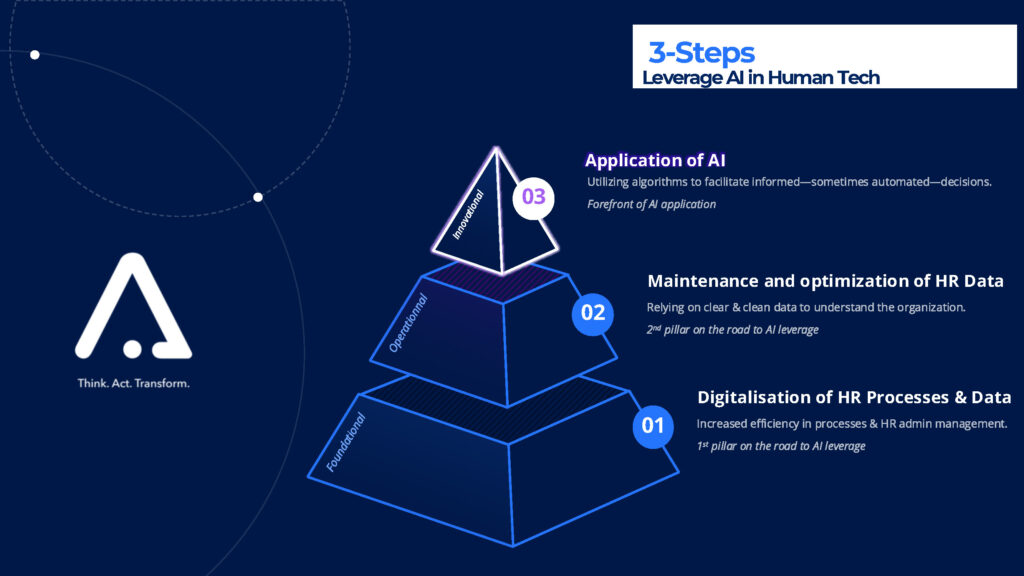
To meet these challenges, it is essential that companies equip themselves with high-performance tools and are equipped to effectively manage digital transformation. Digitization helps to structure day-to-day work, while meticulous data management and regular team upgrades ensure that artificial intelligence unfolds its full potential.
Advanced digital systems, combined with a clear strategy, enable the employer to improve the customer experience and enhance recruitment by valuing everyone's skills. Initiatives such as webinars and training workshops also help to better understand and integrate cutting-edge technologies into the company's day-to-day operations.
AUTOMATION: A DOUBLE-EDGED SWORD!
One of the most touted benefits of AI is process automation. Recurring HR tasks, such as payroll management, scheduling or recruitment administration, can be simplified and optimized.
AI-based tools can detect errors, automatically update schedules and optimize resource allocation. Yet this automation also raises significant challenges:
- How can we ensure that managers remain involved in key decisions, rather than blindly validating automated recommendations?
- How many validation steps are really needed before automation becomes counter-productive?
- What happens if a key decision-maker is unavailable?
AI can reduce the risk of human error, but only if organizations design processes that strike the right balance between technological efficiency and human supervision. It should be used as a decision-making aid, without replacing the critical judgment essential to HR operations.
So, by integrating intelligent automation tools, the company can improve its service while maintaining team involvement. In an environment marked by telecommuting and increased market competition, it is essential for managers to remain attentive to the specificities of each situation, whether in terms of data management, recruitment or training. This approach also makes it possible to anticipate industry trends and adjust the overall strategy to meet current and future requirements.
FASTER DECISION-MAKING: AT WHAT PRICE?
Predictive analytics and AI can speed up HR decision-making, identifying recruitment trends, forecasting departures and optimizing talent management. However, for these decisions to be informed, several conditions must be met:
- A well-structured HRIS, capable of collecting the right information without burdening candidates and employees with cumbersome processes.
- Performance indicators based on objective, unbiased criteria.
- Continuous updating of skills repositories to ensure their relevance.
While predictive analysis is powerful, it relies on accurate data. Without rigorous maintenance of this information, recommendations can be misleading, reinforce certain biases or offer limited added value. To meet this challenge, it is important for every organization to have a solid strategy that integrates both in-depth research and the use of modern tools.
PERSONALIZATION: REAL OR SUPERFICIAL?
AI promises an ultra-personalized employee experience, with tailored training paths and individualized career development plans. However, for this personalization to be truly effective, it is imperative that employees are viewed as unique individuals, and not simply as information aggregated by an algorithm.
AI-based recommendations must answer key questions:
- Does the system collect and update the right data exhaustively?
- Who is responsible for continuously checking the accuracy of information?
- How can we ensure that AI doesn't reproduce existing biases instead of fostering genuine growth opportunities?
HR teams need to invest time and resources to guarantee data quality and fully exploit the potential of personalization. This requires a combination of training, strategic information management and regular monitoring of labor market trends.
A well thought-out personalized approach is based on close collaboration between artificial intelligence and HR teams. By integrating generative solutions into the recruitment process, we can identify new talent and offer career paths tailored to each individual's skills.
By valuing both individual and collective experience, organizations can offer a service that meets the expectations of both internal and external customers, while ensuring continuous evolution in a fast-changing sector.
AI REMAINS A TOOL, NOT A SUBSTITUTE FOR HR EXPERTISE
AI has the potential to transform HR, but it should never replace HR professionals. Rather, it should enable them to access better analytics and gain greater efficiency.
The success of AI in HR rests on three essential pillars:
- Data quality: clean, structured and regularly updated information.
- Strategic alignment: AI insights must serve long-term HR and business objectives.
- Human supervision: AI must complement the know-how of teams, without replacing their judgment.
HR experts play a central role in guaranteeing data accuracy, limiting risks and ensuring that technology meets the organization's concrete needs. By adopting an approach that combines research and continuous training, they optimize processes while maintaining human management of digital transformation.
TO GO FURTHER... AND BUILD THE RIGHT FOUNDATIONS
The potential of AI in HR is real, but taking advantage of it requires more than enthusiasm. We need to invest in data quality, optimize digital processes and ensure that AI enriches HR strategy without dictating it, even in times of crisis.
- Assess information maturity - Are your HR files sufficiently structured and reliable?
- Prioritizing reasoned automation - In what areas can AI really improve efficiency without compromising supervision?
- Adopt an evolutionary approach - Artificial intelligence is advancing, as are HR strategy requirements.
AI isn't a silver bullet, but with a solid foundation, it can become a powerful asset for innovative HR teams. Are you ready to harness its full potential?
Discover ACT-ON HRIS & ACT-ON DATA. Have a project in mind? Get in touch with us.
2025 looks to be a decisive year for companies seeking to fully leverage the power of their data and AI. In a context where digital transformation is everywhere, the ability to innovate, automate processes and anticipate customer needs is crucial to stand out in an increasingly competitive market.
Additionally, adapting employees’ skill sets to new technologies and digital tools will be a key success factor.
At ACT-ON GROUP, especially within our data business line, we analyzed the 10 major trends set to drive organizational and technological evolution in the coming months. These issues - spanning cybersecurity, data management and user experience - are shaping how strategic decisions will be made.
1. THE EVOLUTION OF GENERATIVE AI MODELS
This year, generative models like ChatGPT will take a new step in corporate adoption. These tools won’t just generate text content but will play a key role in advanced data analysis.
However, these future smart agents will reshape work by letting employees focus on higher-value tasks while AI handles automated analytical processes and reporting.
Companies will harness these algorithms to produce dynamic dashboards, craft complex forecasts and automate report generation. This deeper integration will enhance analytics capabilities while simplifying decision-making. It represents a major shift in how organizations approach data management. [1]
2. THE RISE OF DATA MESH
Centralizing data is gradually giving way to the Data Mesh concept, granting greater control to business teams and encouraging broader collaboration and faster decision-making. [2]
Each team can now focus on tasks tied to its particular expertise, while following unified governance rules.
HR, marketing or finance departments will have direct access to relevant information.
This distributed model meets the need for agility and speed, transforming data management so each player is both a user and a contributor.
3. GREATER FOCUS ON RESPONSIBLE DATA
In a world where cybersecurity and data privacy are critical, companies must prove they use data and technology ethically and transparently.
In 2025, “data ethics” labels will be a new mark of trust! [3]
Those who ignore these issues will lose the trust of customers and partners. Fighting algorithmic bias and complying with GDPR will be essential. Responsible data management becomes imperative in an ever more regulated environment!
4. AUTOMATING DATA GOVERNANCE
Faced with ballooning data volumes and complexity, organizations are investing in automated solutions to ensure compliance.
In data management, lineage tools, automated catalogs, and smart classification systems will track data flows in real time and cut down on human error. This approach transforms how data resources are used, ensuring safer, more effective utilization.
5. A “DATA-FIRST CULTURE” IN DAILY OPERATIONS
Data will no longer be reserved for analysts or IT experts.
First, low-code and no-code tools will let non-technical staff handle complex information, generating strategic insights. [5]
Second, this democratization fosters a data-first culture, empowering every employee to drive innovation and decision-making!
If adopted, this approach will boost business competitiveness by speeding up and refining decision-making.
6. THE EXPLOSION OF REAL-TIME DATA PLATFORMS
Demand is mounting for technologies that can process real-time data streams.
Companies are deploying solutions to gather, analyze and utilize data instantly. These platforms are vital to industries like e-commerce, logistics or finance, improving reactivity and user experience! [6]
Such tools directly address rapidly changing markets, where every second counts in decision-making.
7. MORE EFFICIENT HYBRID PREDICTIVE MODELS
By combining classic algorithms with deep-learning techniques, hybrid models deliver more accurate results in areas like inventory management and sales forecasting.
This tech evolution lowers costs while raising operational efficiency. As a result, such models will become indispensable for users tackling intensifying market demands. [7]
8. DATA SOVEREIGNTY AS A STRATEGIC LEVER
Data location and management remain top priorities, especially in the face of ever-stricter regulations. Companies must keep data in environments compliant with local laws and maintain strong cybersecurity.
This push toward greater sovereignty unfolds in a context where global relations directly influence how organizations implement digital technologies. [8]
9. STRONGER HUMAN-AI COLLABORATION
AI doesn’t aim to replace humans but to expand their expertise.
This year, data teams will work closely with algorithms to interpret complex data and solve strategic issues.
Such teamwork blends AI’s analytical power with human creativity, unlocking groundbreaking project-management outcomes. [9]
10. FOCUS ON DATA SUSTAINABILITY
Sustainability goes beyond products to also include data infrastructure.
Companies will seek to reduce environmental impact by optimizing data centers and implementing eco-friendly cloud storage practices.
This approach meets user expectations and mirrors greater global awareness of environmental challenges. [10]
This year stands as a major turning point for businesses. Those able to harness these data trends and translate them into strategic implementations will remain competitive and innovative.
All in the midst of a tense macroeconomic climate with tough competition—both commercially and in recruiting top talent.
That’s why we recommend embracing these new practices and solutions now to gain a competitive edge aligned with market and user needs. Companies that seize this transformation will gain a head start, as data-driven innovation will underpin strategic decisions.
So, are you ready to turn data into a competitive advantage? HR, Comp & Ben, executives… start getting the most out of your data now with our DATA for people solution.
Discover ACT-ON DATA. A project? Contact us.
[1] ProactiveAcademy, ChatGPT and its business impact
[3] OpenDataSoft, Data Ethics
[4] JDN, Data Lineage: Definition, Principles and Tools
[5] AWS, What Is Low-Code?
[6] Databricks, Real-Time Analytics Solutions
[7] IBM, Supply Chain Optimization with AI
[8] CNIL, GDPR: What Does It Mean?
[9] Keyrus, AI and Human Interaction
[10] Hellocarbo, Data Center Energy Optimization