







“The World Ahead 2026 ”: a volatile mix… a tipping point for the global balance?

The Economist has released the 40th edition of its annual special issue, "The World Ahead", which explores the major trends and events likely to shape the coming year.
Beyond its ever-prophetic "UNE", open to interpretation and speculation... ACT-ON GROUP offers you a short, forward-looking "reader digest" as 2025 comes to an end, highlighting ten themes that are almost certain to define 2026. A strained global stage, where yesterday’s missteps and today’s uncertainties could exact a steep price !
1 - AMERICA'S 250TH: A HIGH-STAKES ANNIVERSARY!
2026 will mark 250 years since the founding of the United States. The mood is set to be more tense than celebratory. Expect competing narratives from Republicans and Democrats. One side will spotlight democratic and liberal heritage; the other will emphasize internal fractures, inequality and social unrest. In a climate of deep polarization, the anniversary is likely to intensify debates on national identity, collective memory and the country’s political trajectory. Voters will deliver their verdict during the November midterm elections. But even if Democrats retake the House of Representatives, Donald Trump’s grip on power will continue.
2 - GEOPOLITICAL DRIFT: THE UNSETTLED GAME OF ALLIANCES
The world is constantly reshaping itself. The old configuration based on rival blocs led by the United States and China may give way to a patchwork of shifting regional spheres of influence. Neither bipolar nor conventionally multipolar, but a maze of overlapping power centers between the United States, China and Russia. Donald Trump’s transactional approach could intensify this drift and make alliances more volatile. Some countries may find themselves juggling conflicting pressures, a gamble with real consequences. Yet “coalitions of the willing” may also emerge, forging new agreements in defense, trade, or climate policy.
3 - WAR OR PEACE? CONFLICTS DRAG ON, PEACE FALTERS...
The boundary between war and peace will blur in 2026. Beyond active conflicts like those in Ukraine, Sudan or Myanmar, the world will see more gray zone provocations: cyberattacks, maritime pressure, diplomatic escalation and coordinated actions below the threshold of open confrontation. Russia and China are likely to keep testing US commitments to its allies. A fragile lull in Gaza and the broader Middle East might hold, but rising flashpoints in Eastern Europe, the South China Sea, the Arctic, orbital space, deep-sea zones and cyberspace will feed constant instability.
4 - EUROPE... LOSING INFLUENCE, MOMENTUM & COHESION
For the European Union, 2026 will be a delicate balancing act: strengthening defense, staying aligned with the United States, supporting growth and sustaining high public spending, while avoiding public backlash against fiscal tightening. Europe cannot simultaneously modernize its strategic ambitions and guarantee social and green transitions without putting internal cohesion at risk. The result could be rising euroscepticism and a boost for radical parties.
5 - CHINA'S MOMENT ? BETWEEN INTERNAL STRAIN & EXTERNAL AMBITION
Despite domestic weaknesses such as deflation, industrial overcapacity and sluggish growth, China may benefit from the United States’ “America First” stance and expand its influence. Beijing will aim to strengthen its role in the Global South and among the BRICS by offering more predictable commercial and industrial partnerships than those offered by the US. The likely outcome: stronger Chinese influence in pivotal regions, even as Beijing maintains a transactional relationship with Washington rather than outright confrontation.
6 - ECONOMIC WORRIES : WEALTHY COUNTRIES UNDER WATCH...
Developed economies have been living beyond their means for too long, with high public spending, accumulating debt and persistent deficits. Looming in 2026 is the risk of a bond-market crisis capable of triggering a global chain reaction. The uncertainty surrounding the succession of Jerome Powell as Federal Reserve Chair in May will be a decisive moment. A political misstep could hasten the downturn.
7 - Ai: A DOUBLE-EDGED FUTURE
Artificial intelligence continues to draw massive investment in the United States and elsewhere. Yet this feverish momentum may hide economic vulnerabilities. Is the world entering a new tech-finance bubble reminiscent of the eras of electricity, railroads, or the Dotcom boom? If enthusiasm fades, the shock could be severe, with significant repercussions for graduate employment and the broader global economy.
8 - THE CLIMATE CHALLENGE: TIMID PROGRESS & CONTRASTING DYNAMICS
Expectations for 2026 are tempered: keeping global warming to 1.5°C appears out of reach. The resistance of some major powers to energy transitions, sometimes for political reasons, complicates progress. Still, there are hints of change. Clean technologies are taking off across the Global South, and sectors like geothermal power are attracting attention, suggesting underexplored alternatives. The equation is simple enough: technological progress plus political pragmatism equals a glimmer of hope, with no certainty attached!
9 - SPORT & ITS VALUES: MIRRORING GLOBAL TENSIONS
In 2026, sports may no longer offer even a fleeting illusion of unity. The FIFA World Cup, co-hosted by the United States, Canada and Mexico, three countries grappling with trade and migration tensions, could face apathy or boycotts. Meanwhile, the rise of controversial competitions such as the “Enhanced Games,” where athletes may use performance-enhancing substances, raises questions about the future of sporting ethics. Beneath it all, sports could become a reflection of the world’s ideological and social divides.
10 - HEALTH & WELL-BEING: NEW SOCIAL INJUNCTIONS?
Health, and especially the booming market for obesity treatments, may reach a turning point in 2026. New GLP-1 pills, more affordable and accessible than current treatments, could become mainstream. But the debate surrounding these drugs goes further: are they simply treatments, or means of reshaping bodies to meet social expectations of personal performance? It’s a debate that blends economics, well-being and moral judgment.
In conclusion, The World Ahead 2026 offers an unvarnished portrait of a global landscape that is fragile and in flux. A world under strain, where wealthy powers test the limits of their finances while strategic rivalries, economic shocks, technological shifts and planetary fractures reshape the immediate future.
Excessive debt, geopolitical pressure, climate risks and technological upheaval make for a volatile mix. Yet for those able to anticipate, adapt or rethink the rules, opportunities remain. 2026 may well be the moment when the global balance shifts, for better or worse
The bet is on.
In the special issue The World Ahead 2026, journalists from The Economist are joined by leading figures from politics, economics, science and beyond.
Contributors include Kaja Kallas, European Commissioner for External Relations and Security; Mark Carney, Prime Minister of Canada; Nandan Nilekani, co-founder and chairman of Infosys; Jack Goldsmith and Robert Bauer, former US government attorneys; Richard White, professor emeritus of American history at Stanford University; Kristalina Georgieva, managing director of the IMF; and Heidi Larson, vaccine anthropologist at the London School of Hygiene & Tropical Medicine.
They share their insights and expectations for the year ahead.
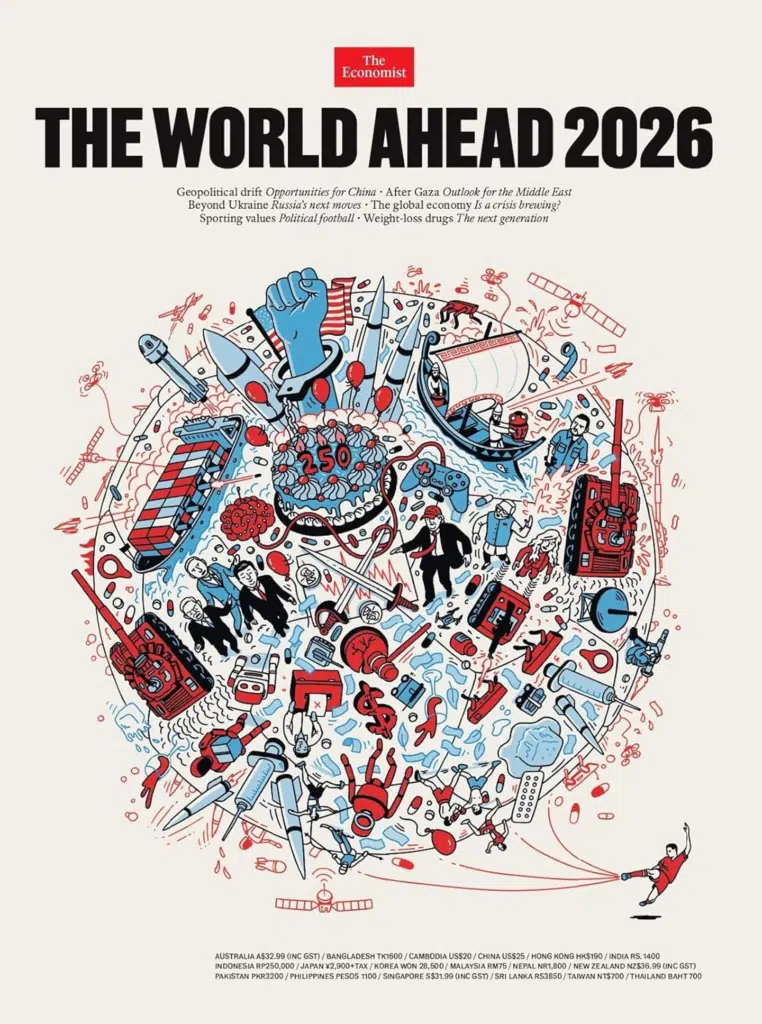
Full issue available at:
The Economist - The World Ahead 2026
Need an audit, a benchmark, a prospective analysis... Contact us!
You may also like…